Specialist Directory · Metro Atlanta

Board-certified doctors for tennis elbow in Atlanta

Lateral epicondylitis is a specific condition that responds to specific care. Finding a physician who treats it regularly — not just occasionally — makes a measurable difference in how fast you recover.

See Specialists Common Questions
5
Listed Atlanta specialists
30+
Years combined experience
2
Practice types covered
95%
Cases resolved non-surgically

Common Questions

What patients ask before their first appointment

These are the questions doctors hear most often from new tennis elbow patients in Atlanta.

Do I need a referral to see a tennis elbow specialist?
Most sports medicine and pain management physicians accept self-referrals. You don't need a referral from a primary care doctor to schedule a consultation directly. Call the office and they'll confirm your insurance requirements.
Should I see an orthopedic doctor or a pain management doctor?
For most new or moderate cases, a sports medicine or non-operative orthopedic physician is the right starting point. If pain is severe, long-standing (6+ months), or limiting your work and daily activities, a pain management specialist can provide more aggressive interventional options including PRP and advanced injection therapies.
How long does it take to get better with treatment?
With appropriate specialist care, most patients see significant improvement within 6–12 weeks. Chronic cases (12+ months) take longer. The key variable is starting the right treatment early — cases that go untreated for months become substantially harder to resolve.
Will I need surgery?
Fewer than 5% of tennis elbow cases require surgery. The physicians listed here specialize in exhausting conservative options first — rest, physical therapy, bracing, corticosteroid injections, and PRP therapy — before considering surgical intervention.
Does insurance cover tennis elbow treatment?
Most major insurance plans cover evaluation and standard conservative treatments. PRP therapy is often not covered by insurance as it's considered experimental by many carriers. Call the specialist's office directly to verify your coverage before your first appointment.

Advanced Treatment

Ultrasound-guided percutaneous tendon debridement

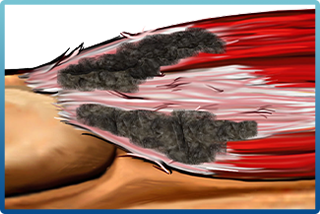
For chronic lateral epicondylitis that has not responded to conservative care, a minimally invasive procedure is available that physically removes the diseased tendon tissue — rather than masking symptoms with injections.

How it works

Under continuous ultrasound guidance, the treating physician makes a small incision and advances a small-gauge device directly to the degenerative portion of the common extensor tendon at the lateral epicondyle. A precise, high-pressure saline jet simultaneously breaks down and removes the damaged collagen — an integrated aspiration channel clears the debris as healthy fibers are left intact. The entire procedure typically takes 15–30 minutes in an office or clinic setting under local anesthesia.

Why it works for tennis elbow specifically

Chronic lateral epicondylitis is a tendinopathy — a degenerative condition — not a simple inflammation. Cortisone injections reduce inflammation temporarily but do not address the underlying degenerated collagen, which is why pain returns. This procedure mechanically removes that degenerative tissue at the common extensor or flexor origin, targeting the actual source of chronicity. Results are confirmed under real-time imaging.

How it compares
Cortisone injection
Reduces inflammation temporarily. Does not remove degenerative tissue. Pain typically returns within weeks to months.
Percutaneous debridement
Physically removes degenerative collagen under ultrasound guidance. Small incision, local anesthesia, office procedure. Addresses the source.
PRP therapy
Stimulates a healing response but does not remove existing diseased tissue. Complementary, not equivalent.
Surgical release
Open or arthroscopic tendon release. Effective but requires surgical center, general anesthesia, and longer recovery.
Small incision, performed in-office under local anesthesia
No general anesthesia or surgical center required
Real-time ultrasound guidance throughout
Most patients return to normal activity within days to weeks
Treats the degenerative tissue — not just the pain

Atlanta Specialists

Doctors treating tennis elbow in Atlanta

Board-certified physicians across sports medicine and interventional pain management. All practice in the Atlanta metro area.

CG
Dr. Clay Charles Guynn, DO
Sports Medicine · PM&R
Northside Hospital Orthopedic Institute
Lawrenceville & Dacula · (770) 237-3475

Fellowship-trained. Ultrasound-guided injections, PRP, and comprehensive rehab protocols for elbow tendinopathy.
MS
Dr. Matthew Simmons, MD
Non-Operative Orthopedics
Northside Hospital Orthopedic Institute
Metro Atlanta · (770) 237-3475

Non-operative orthopedic specialist. Focused on resolving musculoskeletal conditions without surgery.
KK
Dr. Kamal Kabakibou, MD
Interventional Pain Medicine
Center for Pain Management
Atlanta, GA · (404) 603-9090

30+ years experience. Baylor fellowship. Full spectrum of pain management and regenerative therapies.
EO
Dr. Efosa Ogiamien, MD
Interventional Pain Medicine
OlympusMD Pain & Wellness
Metro Atlanta · (770) 676-9805

UAB fellowship-trained. Founding partner of OlympusMD. Advanced regenerative medicine and injection procedures.
OH
Dr. Omar Hajmurad, MD
Interventional Pain Medicine
OlympusMD Pain & Wellness
Metro Atlanta · (770) 676-9805

Emory fellowship-trained. Board-certified anesthesiologist and interventional pain specialist.

Need help choosing the right specialist?

Jeff Karesh works directly with each physician listed here as a medical device sales specialist. He knows their practices, their approaches, and can help match you with the right doctor for your specific situation — at no cost to you.

Call Jeff Karesh
Name
Jeff Karesh
Phone
(912) 247-8925
Role
Medical Device Sales Specialist
Orthopedic & Pain Management